
The slowest queue in hiring
7.1 million openings, a 3.3% hires rate, 1.9 million people waiting six months. Hiring's slowest queue is the first round.
The slowest queue in hiring
The recruiter has been at her desk for eleven minutes when the first chaser arrives. A hiring manager, polite but pointed: any movement on the ops role? It opened in August. She knows the date without looking, because the req has become a fixture of her Monday.
She opens the queue. The role has four hundred and eleven applicants. She has screened sixty-two. Nine made the shortlist. Three have already accepted other offers.
Nothing about this week is unusual. That is the point.
The market that will not move
The Bureau of Labor Statistics counted 7.1 million open jobs in the United States in August (JOLTS, released 29 September 2026). The hires rate was 3.3%. Openings are not scarce. Conversion into actual hires is.
September's employment report made the same point from the other side. Employers added 29,000 jobs in a month, against an average of 45,000 a month over the prior year (BLS Employment Situation, released 2 October 2026). Demand on paper has held. The machinery that turns demand into a signed offer has slowed.
And the queue keeps growing. 1.9 million people have now been out of work for six months or longer, 27.1% of everyone unemployed (same report). They are not short of openings to apply to. They are short of a process that moves.
Three dancers, one bottleneck
Hiring is a three-sided dance, and right now all three sides are losing to the same thing.
The recruiter is rationing. Carrying dozens of open roles and hundreds of applicants per role, she cannot give every candidate a considered read, so she gives most of them no read at all. The ones she does reach wait days for a thirty-minute call that could have happened the day they applied.
The company is screening volume it never budgeted for. Every req now attracts multiples of the applications it did three years ago, and the review capacity did not multiply with it. The response is usually a harder filter, which cuts noise and signal together and sends the good candidates to whoever answered faster.
The candidate is waiting in the dark. They apply, hear nothing, follow up, hear nothing, and read the silence as a verdict. Often there is no verdict. There is a queue, and they are in the part of it nobody has reached yet.
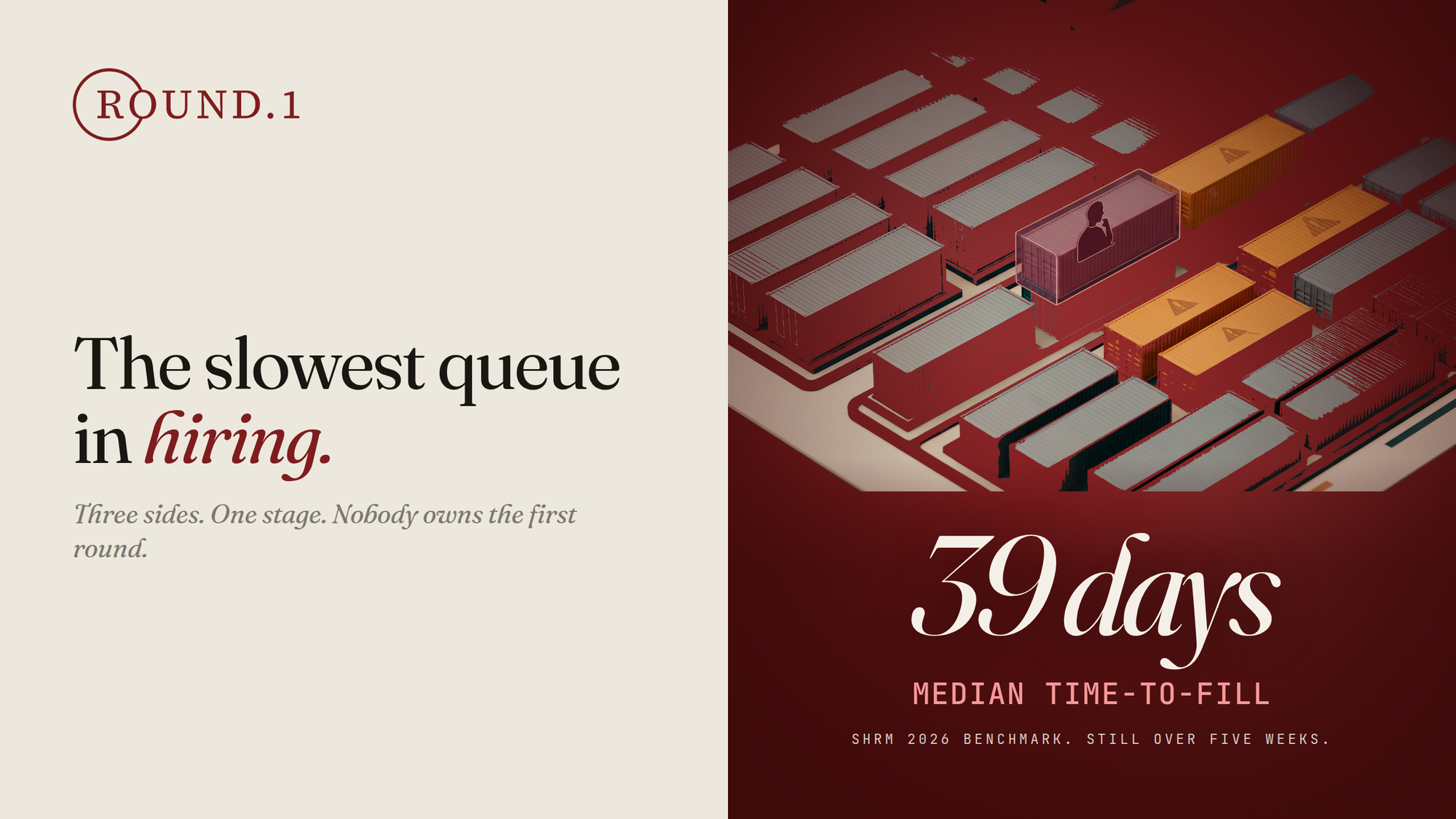
The median time to fill a non-executive role is 39 days (SHRM 2026 recruiting benchmarks, requisition open to offer accepted). Five weeks, most of it spent not deciding, but queuing ahead of the decision.
The stage nobody owns
Follow a requisition through its thirty-nine days and a pattern emerges. Sourcing has a budget. The final interview has a calendar and a panel. The offer has an owner and a deadline.
The first round has none of these. It has a spreadsheet, a recruiter with forty open roles, and a backlog that resets every Monday. It is the only stage in the funnel with no headcount, no SLA, and no record of what it produced.
Yet the first round is where the dance is won or lost. It decides who is worth a hiring manager's hour. It consumes most of the calendar allocated to hiring. And it generates the least evidence per hour of anything in the process: a rushed screen, a half-remembered impression, a verdict nobody can reconstruct. When the first round is slow, every opening ages. When it is shallow, every rejection looks arbitrary. When it is buried, the good candidates accept other offers and the queue learns nothing.
The quiet version
It is reasonable to ask whether the first round should be a process at all, or whether its looseness is what keeps hiring human. But notice what the looseness actually produces: not more humanity, more waiting. The candidate who never gets a call is not experiencing a human process. They are experiencing an absent one.
The fix is not a bigger filter or another sourcing push. It is giving the slowest queue in hiring the boring dignity of a stage that is owned: consistent questions, a cost per candidate the team can sustain, and a record of what was asked and answered. The dance does not need better dancers. It needs a floor.
7.1 million openings. 1.9 million people waiting six months to hear anything. Between them sits a queue nobody built on purpose, and nobody owns.