
The Market That Does Not Add Up
America counts 7.3 million job openings and 7.0 million unemployed people. One opening per seeker should clear in weeks. It does not. Something between the two numbers is broken.
The market that does not add up
The recruiting director reads two headlines before coffee. The first says there are 7.3 million open jobs in America. The second says there are 7.0 million unemployed people in it. She closes the laptop, opens the applicant tracking system, and watches twelve more applications land on a role that has been open since June.
Both headlines are true. That is the problem.
The numbers, side by side
The Bureau of Labor Statistics counts 7.3 million job openings across the United States (JOLTS, July 2026). It counts 7.0 million unemployed people (August 2026 employment report). The unemployment rate is 4.1%, and employers added 162,000 jobs in August. On paper, that is roughly one opening for every person looking. On paper, nobody should be stuck.
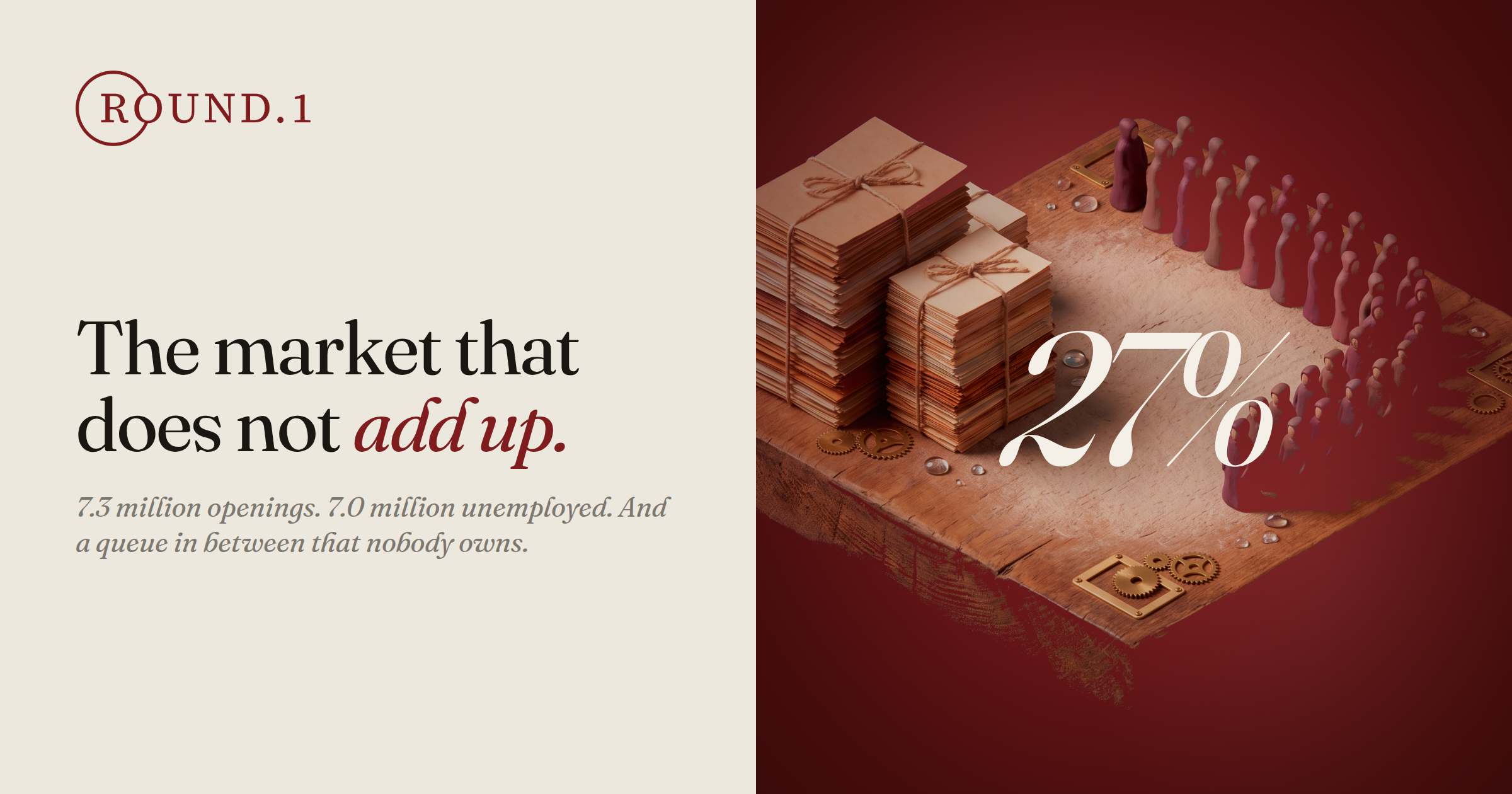
Then there is the other paper. Of those 7.0 million unemployed, 1.9 million have been without work for more than six months. That is 27% of everyone unemployed, up from 25.5% a month earlier (all BLS figures above). The long-term queue is growing while the openings pile up.
A market with one opening per seeker should clear in weeks. Instead it produces a growing queue of people the market will not absorb, and a growing stack of openings the queue cannot fill. Something between the two numbers is broken, and it is not the arithmetic.
The bottleneck has a name
Ask any leader of hiring where the queue forms and the answer is the same: the first round.
Not the interviews that close a hire. The first round: the screening pass that decides who gets taken seriously. Every other part of the funnel has a budget. The first round has a spreadsheet, a recruiter with forty open roles, and a backlog that resets every Monday.
The first round decides who is worth a hiring manager's hour. It consumes most of the calendar allocated to hiring. And it produces the least evidence per hour of anything in the funnel: a thin call, a hurried scan, an impression. When the first round is slow, every opening ages. When it is shallow, every rejection looks arbitrary. The 27% did not spend six months in the queue because of a shortage of people or a shortage of openings. They spent it there while the first round decided nothing.
Two curves going the wrong way
An open role depreciates. The requirements that made sense in June have been renegotiated, the hiring manager's confidence in the shortlist has been revised down, and the remaining applicants get read as the ones nobody else took. Post a role long enough and the definition of fit quietly narrows until almost nobody is hireable against it.
An unemployed candidate depreciates faster. Recruiters read the gap as a verdict, and every algorithmic screener reads it the same way. The 1.9 million long-term unemployed are not failing to find work at random. They are failing to find it systematically, at the stage where a tired screen decides their trajectory in ninety seconds or less.
These two curves cross in every funnel in the country. The longer the opening sits, the less it trusts the queue. The longer the candidate queues, the less the queue trusts them. That is the mechanism that keeps 7.3 million openings and 7.0 million unemployed people coexisting in the same market.
What a first round should cost
A first-round screen is a production process: it has a defined input, a defined output, and a cost per unit. Right now the full cost of treating improvisation as a screen includes the vacancy cost of the role and the compounding damage done to everyone in the queue.
It is fair to ask whether the first round should run with production discipline at all, or whether intuition is what makes it human. But notice the current arrangement does not reward intuition. It rewards whatever is quickest, and then calls the verdict judgement.
The first round deserves the boring dignity of a process: consistent questions, recorded reasoning, a cost per candidate that is sustainable. Give the screen structure and the queue starts moving. Leave it to improvisation and the two numbers keep each other company.
7.3 million openings. 7.0 million unemployed. And a queue in between that nobody built on purpose and nobody owns.
Sources: U.S. Bureau of Labor Statistics, Employment Situation, August 2026 (released 4 September 2026) · U.S. Bureau of Labor Statistics, JOLTS, July 2026 (released 1 September 2026). Long-term unemployed = 27+ weeks, 1.9M people, 27.0% share of unemployment in August (vs 25.5% in July). bls.gov blocks automated fetches; figures are attributed to the BLS releases per the sourcing rule, via secondary reportage of the release.